The massacre at Jatibhanga in Thakurgaon remains one of the darkest episodes of the 1971 Bangladesh Liberation War. Thousands of innocent Hindu refugees were reportedly killed by the Pakistani Army and its local collaborators, leaving hundreds of women widowed and entire communities devastated.
THAKURGAON, BANGLADESH — 23 April 1971
On 23 April 1971, a horrific massacre unfolded at Jatibhanga, in the present-day Thakurgaon district of northern Bangladesh. Hundreds of Hindu families who had gathered near the Pathraj River while attempting to flee to neighbouring India became victims of mass violence carried out by the Pakistani Army and its local collaborators, known as Razakars.
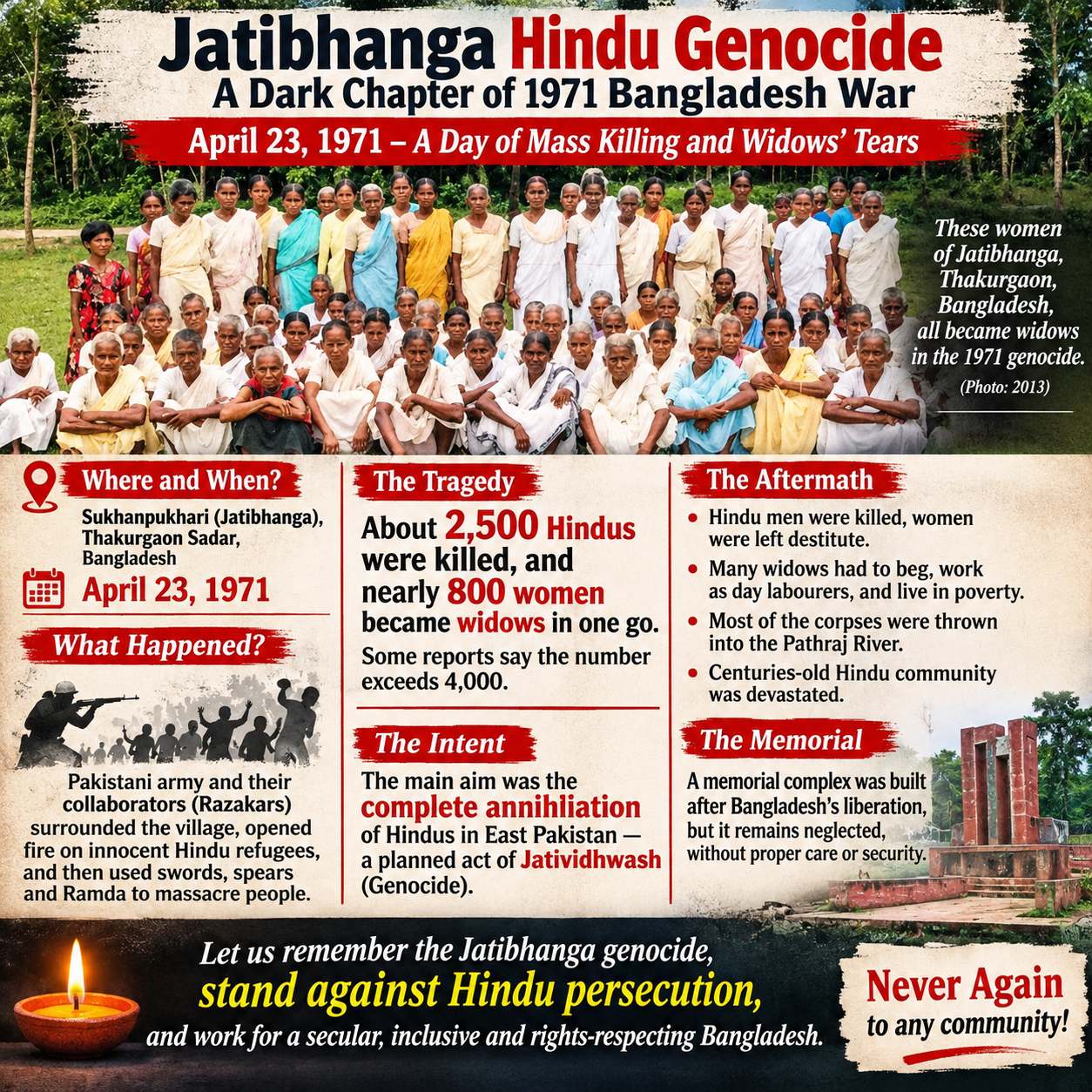
The massacre left an enduring scar on the Hindu community. According to accounts of the tragedy, approximately 2,500 Hindu men were killed, while some estimates place the death toll above 4,000. Nearly 800 women reportedly lost their husbands in a single day, transforming families and neighbouring villages into communities of widows.
Today, the women who survived that tragedy stand as living witnesses to one of the most painful chapters of Bangladesh’s history.
A refuge turned into a killing ground
During the 1971 Liberation War, Hindus across different parts of East Pakistan faced persecution, violence and fear. Many attempted to escape across the border into India in search of safety.
The villages around Sukhanpukhari and Jatibhanga became temporary places of refuge for people fleeing violence elsewhere. Hindu families from Thakurgaon Sadar, Chakhaldi, Singhia, Chandipur, Balia, Rashdevpur, Milanpur and surrounding settlements reportedly gathered in the area before continuing their journey towards India.
On 22 April, many refugees reached the banks of the Pathraj River. Local Razakars reportedly assured them that they could spend the night safely and continue towards the border the following morning.
However, information about the gathering was allegedly passed to the Pakistani military by local collaborators.
What followed was a devastating betrayal.
23 April 1971: The massacre
Early on Friday, 23 April, refugees began preparing to move towards the border. Their journey was reportedly delayed after being told that a bridge over the Pathraj River was under repair.
As the morning progressed, Pakistani soldiers and Razakar collaborators arrived in the area in military vehicles. The surrounding locations were reportedly encircled, while Hindu men were forcibly gathered near the riverbank.
The soldiers opened fire on the unarmed refugees.
People desperately attempted to escape, but many were shot. Accounts of the massacre describe how, after ammunition was exhausted or depleted, attackers also used traditional weapons, including swords, spears and ramdas, to kill victims.
The scale of the killings was so enormous that the Pathraj River reportedly became filled with the bodies of the dead.
Kishor Burman, a teacher at Sukhanpukhari High School who witnessed the events, later described the horror of the massacre. His account recalled people running for their lives, falling under gunfire and bodies and skulls being seen floating in the river after the killings.
Nearly 800 women became widows
One of the most devastating consequences of the Jatibhanga massacre was the destruction of family life.
The victims were predominantly ordinary, unarmed Hindu men, many of whom had been attempting to protect their families and escape the violence of the war.
Their deaths left hundreds of women without husbands, often with children to support and no means of financial survival.
According to accounts of the aftermath, nearly 800 women from Jatibhanga and surrounding villages became widows. Many lost not only their husbands but also sons, relatives, homes and livelihoods.
Before the massacre, many of these families had lived relatively stable lives. Following the killings and widespread looting, survivors were left destitute.
Some women were forced to beg for food. Others became daily-wage labourers, struggling to raise their children and rebuild their lives in the aftermath of unimaginable loss.
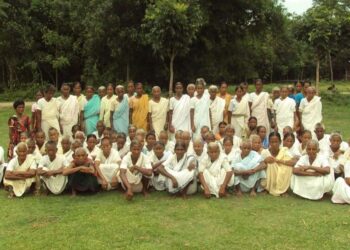
The photograph of the Hindu widows of Jatibhanga, taken in 2013, remains a powerful reminder of this human tragedy. The women pictured represent the lives forever changed by the massacre.
A targeted Hindu community
The Jatibhanga killings must also be understood within the wider context of the persecution of Hindus during the 1971 Liberation War.
Hindu communities were particularly vulnerable during the conflict. Many were forced to flee their homes, while others faced killings, looting, destruction of property and displacement.
The targeting of Hindu refugees at Jatibhanga illustrates the devastating consequences of religious persecution and organised violence against a vulnerable civilian population.
The massacre is remembered by survivors and local accounts as an attempt to eliminate the Hindu male population from the surrounding communities, leaving women and children exposed to poverty, insecurity and displacement.
The term Jatividhwash, meaning the destruction or annihilation of a community, has been used by some to describe the scale and character of this tragedy.
A neglected memorial and a forgotten history
After Bangladesh achieved independence in December 1971, a memorial plaque and complex were established at Jatibhanga to honour those who lost their lives.
However, concerns have been raised about the inadequate maintenance and protection of the memorial. Accounts describe a lack of proper supervision, security and preservation, raising questions about the attention given to one of the country’s most painful historical events.
For the survivors and descendants of the victims, remembering the massacre is not simply an exercise in historical commemoration. It is a demand for recognition, dignity and justice.
The stories of the widows deserve to be documented, their testimonies preserved, and the memorial protected for future generations.
Never forget Jatibhanga
More than five decades have passed since that terrible April morning. The generation that witnessed the massacre is gradually disappearing, making the preservation of survivor testimonies and historical records increasingly urgent.
The women photographed in 2013 remind us that behind every reported death toll was a human life, a family and a future that was taken away.
The Jatibhanga massacre should not remain a forgotten footnote in the history of the Bangladesh Liberation War. Its victims deserve recognition, and the suffering of the survivors deserves to be remembered.
Remembering Jatibhanga is also a reminder of the importance of protecting religious minorities, defending human rights and resisting communal hatred.
History must remember the victims. Justice must acknowledge their suffering. And humanity must ensure that such atrocities are never repeated.
Never again should any community face persecution, collective violence or destruction because of its religious identity.